
TL;DR
- -Pool shape affects cost, function, aesthetics, and how well the pool fits your yard more than almost any other design decision, so it deserves serious research before you commit.
- -Rectangular and geometric shapes are the most cost-efficient and work beautifully with nearly any home style, making them a smart default for homeowners who prioritize clean lines or lap swimming.
- -Freeform and organic shapes integrate naturally into wooded and landscaped lots common around Lake Norman, but they require custom gunite construction and a larger investment.
- -L-shapes and divided pool designs are ideal for families who need separate deep and shallow zones, giving different age groups their own space within a single pool.
- -Your lot size, red clay soil conditions, local setback rules in Mecklenburg and Iredell Counties, and any HOA restrictions are all real factors that must guide your final shape selection.
Why Pool Shape Is One of Your Most Important Decisions
When most homeowners start dreaming about a new pool, they focus on features first: a tanning ledge here, an in-wall waterfall there, maybe smart automation to control everything from a phone. But long before any of those features can be selected, there is a decision that influences nearly everything else about the design, cost, and long-term enjoyment of your pool: the shape.
Shape determines how the pool fits your yard, how it flows with your home's architecture, how it functions during different types of use, and to a meaningful degree, what you will pay to build and maintain it. Getting the shape right from the beginning means a backyard that feels intentional and cohesive. Getting it wrong means a beautiful pool that never quite fits the space it lives in.
At Rock Water Pools, we design custom pools throughout greater Charlotte, Lake Norman, and surrounding communities in North and South Carolina. One of the first conversations we have with every client is about shape, and we want you to walk into that conversation informed.
The Geometric Classics: Rectangle and Square
The rectangle is the most universally requested pool shape, and for good reason. It is clean, versatile, and timeless. It fits virtually any architectural style from traditional colonial to clean-lined modern, and it uses yard space efficiently. A rectangle is also the most predictable shape in terms of construction cost, because it involves fewer complex curves or custom cuts.
Rectangles are the top choice for homeowners who want to swim laps or use the pool for exercise. The long, uninterrupted lanes make fitness swimming practical and satisfying. They also provide a clear visual boundary that works well in formal garden settings or in yards where a clean, geometric landscape design is a priority.
Square pools are far less common but can make a dramatic statement in smaller or symmetrical yards. They work especially well as plunge pools or as the centerpiece of a compact but intentionally designed outdoor living space. If a standard lap pool is too long for your lot but a truly distinctive look appeals to you, a large square can be an elegant and unexpected solution.
L-Shape and T-Shape: Zones for Every Use
For families who want a pool that can serve more than one purpose at a time, L-shape and T-shape designs are outstanding solutions. The concept is straightforward: each arm or wing of the shape serves a distinct purpose. One zone might be the deep end for diving and open swimming, while the other is shallower and designed for children, a sun shelf integration, or a connected spa.
L-shaped pools are especially popular among families with young children in the Charlotte and Lake Norman markets. Parents can supervise from a central position while older swimmers use one area and younger children play safely in the shallower zone. The layout naturally creates a sense of separation without requiring any physical barriers inside the pool itself.
From a construction standpoint, L-shapes and T-shapes remain geometric in nature, meaning standard fiberglass shell options sometimes cover the more common variants. Fully custom configurations are typically executed as gunite builds. They do tend to cost more per square foot than a simple rectangle because of the added complexity at the transition point between zones.
Freeform and Organic Shapes: Where Nature Meets Design
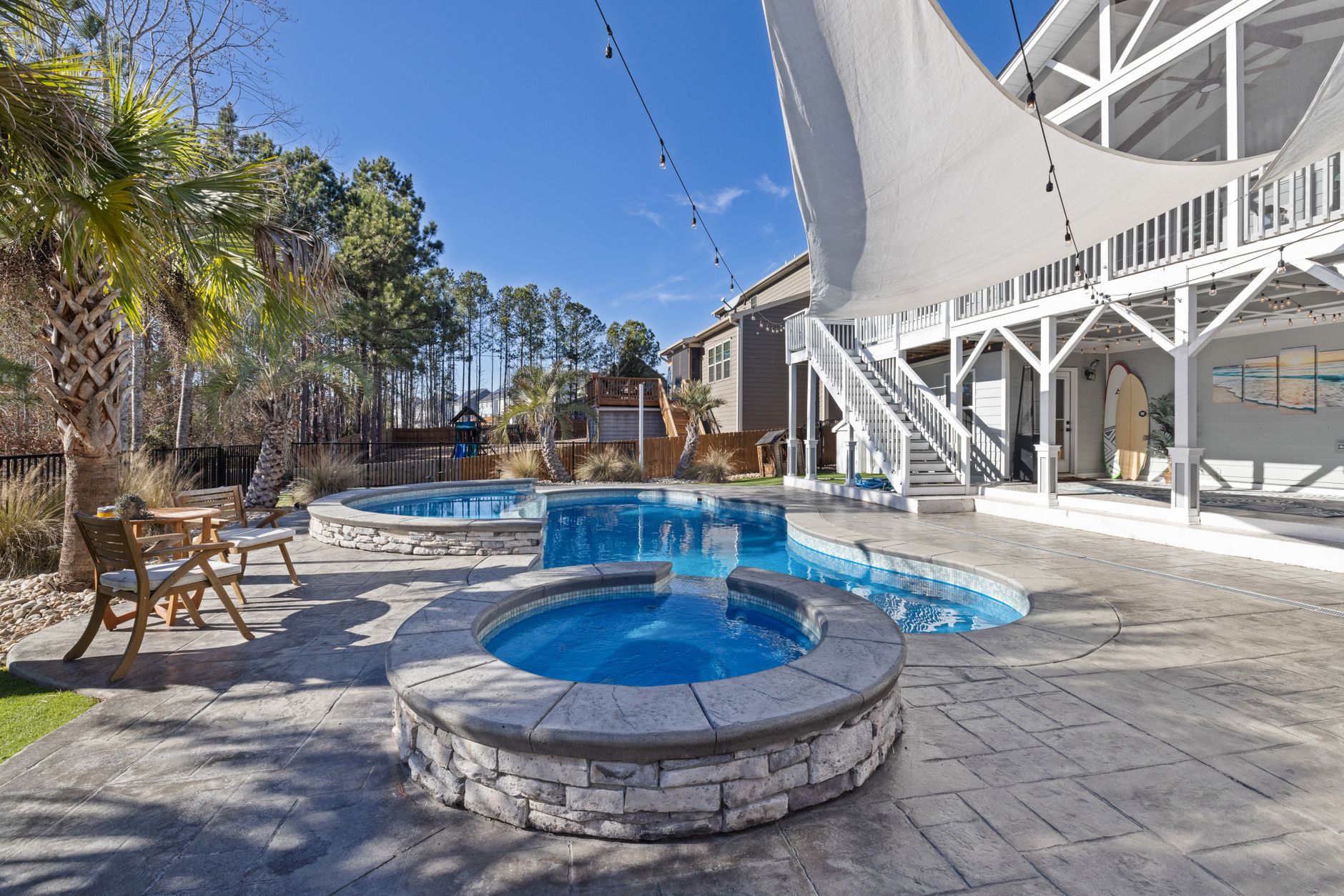
Freeform pools are defined by flowing, irregular curves that feel as though they occurred naturally rather than being drafted on a grid. They are the quintessential resort pool look, and they integrate beautifully into landscapes that include mature trees, natural stone, or rolling terrain. In the wooded, topographically varied neighborhoods around Lake Norman, freeform designs are consistently among the most requested styles.
The great strength of a freeform pool is its flexibility. Because there are no straight edges, the designer has tremendous freedom to work around existing trees, garden beds, irregular property lines, or existing architectural features. A freeform pool can accommodate a rock waterfall that looks naturally placed, a grotto, a beach entry that transitions seamlessly to the surrounding landscape, or a shape that simply follows the natural contours of the lot.
One important consideration with freeform pools is that they are nearly always custom gunite or shotcrete builds, since the irregular shape cannot be factory-manufactured like a fiberglass shell. This typically means a longer build timeline and a higher price point than a standard geometric shape. The result, however, is a pool that is entirely one of a kind and uniquely tied to its setting.
Kidney, Grecian, and Roman Shapes: Timeless Profiles with Personality
Between the pure geometric shapes and true freeform designs sits a category of classic pool profiles that have been popular for decades: the kidney, the Grecian, and the Roman. Each has a distinctive silhouette that lends a specific character to the backyard, and each has its own strengths in terms of function and visual appeal.
The kidney shape is perhaps the most recognizable of the three. Its signature feature is a concave curve on one long side that creates a natural sense of encirclement, as though the pool is gently embracing the space around it. Kidney shapes work well in yards with curved landscape beds, tropical plantings, or when a resort-style look is the goal without committing to the full irregularity of a true freeform design.
The Grecian shape features straight sides with chamfered, angled corners rather than rounded edges. It reads as formal and architectural, and pairs naturally with brick exteriors, symmetrical landscaping, and the more traditional home styles common in south Charlotte and surrounding suburbs. The Roman shape adds one or two semicircular ends to a similar framework, creating a distinctly classical profile that is elegant, highly symmetrical, and well-suited to formal outdoor living spaces.
How Your Lot and Landscape Drive the Decision
No pool shape exists in isolation. It has to work within the reality of your specific yard: the topography, existing trees, the setback requirements set by your local municipality, and the relationship between the pool and your home's architecture. In Mecklenburg County and Iredell County, setback rules typically require pools to be placed at least ten to fifteen feet from property lines, and many neighborhood HOAs add further restrictions on placement, fencing, and visual screening.
The famous red clay soil of the Carolinas also plays a meaningful role in shaping design decisions. Clay-heavy ground retains water, which affects drainage planning and can create hydrostatic pressure on pool walls if not properly engineered. Your Rock Water Pools designer will assess soil conditions during site evaluation. The practical takeaway for homeowners is that poorly draining lots or significant slopes sometimes steer us toward specific construction approaches, and those choices can influence which shapes are most practical and cost-effective to build.
Sloped lots are actually one of the most interesting opportunities in custom pool design. A well-placed geometric pool on a slope can become a stunning infinity-edge feature with sweeping views of a lake or treeline. A freeform design on a gentle hillside can evoke the feeling of a natural woodland pond. The key is working with a builder who reads the land and turns its quirks into design opportunities rather than treating them as obstacles.
Match the Shape to How You Will Actually Use the Pool
Beyond architecture and lot constraints, your lifestyle should be a primary driver of the shape you choose. Think honestly about how the pool will be used most of the time. If you plan to swim for exercise several mornings a week, a rectangle or a modified lap configuration will serve you far better than a freeform design with curves that interrupt a clean stroke. If the pool will primarily be a social gathering space for summer entertaining, the shape matters somewhat less than the overall flow of the outdoor living area.
Families with young children almost universally benefit from designs that include a clearly defined shallow zone, whether that is a sun shelf, a beach entry, or a separate shallow end distinctly separated from the deeper areas. L-shapes and certain freeform designs accommodate this naturally. Pure rectangles can achieve it through careful planning and strategic use of depth transitions, but it requires more deliberate supervision.
If relaxation and visual impact are your highest priorities, and you imagine floating on a warm afternoon with nothing but the sound of water and the Carolina sky above you, freeform and organic designs tend to create the most inviting atmosphere. They feel like a destination rather than a fixture. For many homeowners with landscaped lots near Lake Norman, that sense of natural retreat is exactly what they are investing in when they call us.
Start Your Pool Design With Rock Water Pools
Choosing a pool shape is not something you should have to figure out on your own. It is a decision that requires a clear-eyed look at your yard, your lifestyle, your budget, and your long-term vision for your outdoor space. The best pool shapes are not chosen from a catalog. They are developed through a conversation with a designer who has built pools in your neighborhood, understands the local soil and permitting landscape, and has the portfolio to show you exactly what is possible.
At Rock Water Pools, we bring that expertise to every consultation. Whether you are drawn toward a clean-lined rectangle for a modern Charlotte home, a flowing freeform design that winds through your Lake Norman landscape, or something uniquely yours that does not fit any single category, we are here to help you develop a design you will love for decades.
Contact Rock Water Pools today to schedule your design consultation. Together, we will take the blank canvas of your backyard and turn it into the outdoor space you have been imagining. One that fits your family, your land, and your vision of Carolina living at its finest.
About the author
Rock Water Pools - Custom Pool Designer & Builder. Mooresville-based custom pool design and build team. Serving Lake Norman, Charlotte metro, and the Carolinas since 2008. Hundreds of completed concrete and fiberglass builds across NC and SC. Questions? Call or text (704) 450-1023.
17+ years building custom inground pools across the Carolinas.